Quick Answer
Commercial battery storage sizing starts with two separate questions:
- How much power must the battery deliver at one time?
- How long must it continue delivering that power?
The first answer determines the power rating in kilowatts or megawatts. The second determines the energy capacity in kilowatt-hours or megawatt-hours.

A reliable commercial battery storage design should be based on at least 12 months of interval load data, preferably recorded every 15 minutes. Monthly electricity bills are useful for an initial review, but they rarely show when a peak occurred, how long it lasted or how frequently it returned.
A practical sizing formula is:
Required nameplate capacity = Required AC energy ÷ (SOC window × discharge efficiency × end-of-life capacity retention)
The final system must also be checked against the electricity tariff, solar production, critical loads, transformer capacity, charging window, ambient conditions, grid rules and future load growth.
The right commercial battery storage system is not the largest system that fits the site. It is the smallest configuration that can reliably achieve the project’s operational and financial objectives over its intended service life.
Why Commercial Battery Storage Sizing Matters
A battery does not create value simply because it has a large capacity.
An undersized system may run out of usable energy before the demand peak ends. It may fail to support critical equipment during an outage or leave part of the facility’s solar surplus unused.
An oversized system creates a different problem. More capital is committed, but the additional capacity may spend much of its life idle. The site may also require larger switchgear, more civil work and additional transformer capacity without gaining proportional savings.
Battery storage deployment is growing quickly. The International Energy Agency reported that 108 GW of new battery storage capacity was deployed worldwide in 2025, 40% more than in 2024. LFP batteries accounted for around 90% of deployments.
That growth gives businesses more product options, but it does not remove the need for careful engineering.
Commercial battery storage systems may be used for:
- peak shaving;
- time-of-use energy shifting;
- solar self-consumption;
- backup power;
- generator fuel reduction;
- grid-import limitation;
- microgrid operation;
- grid services.
Each application produces a different relationship between power and energy. A system designed for a 15-minute demand peak should not automatically be sized like a four-hour backup battery.
Commercial battery storage sizing is therefore an optimization problem, not a catalogue-selection exercise.
What Is a Commercial Battery Storage System?
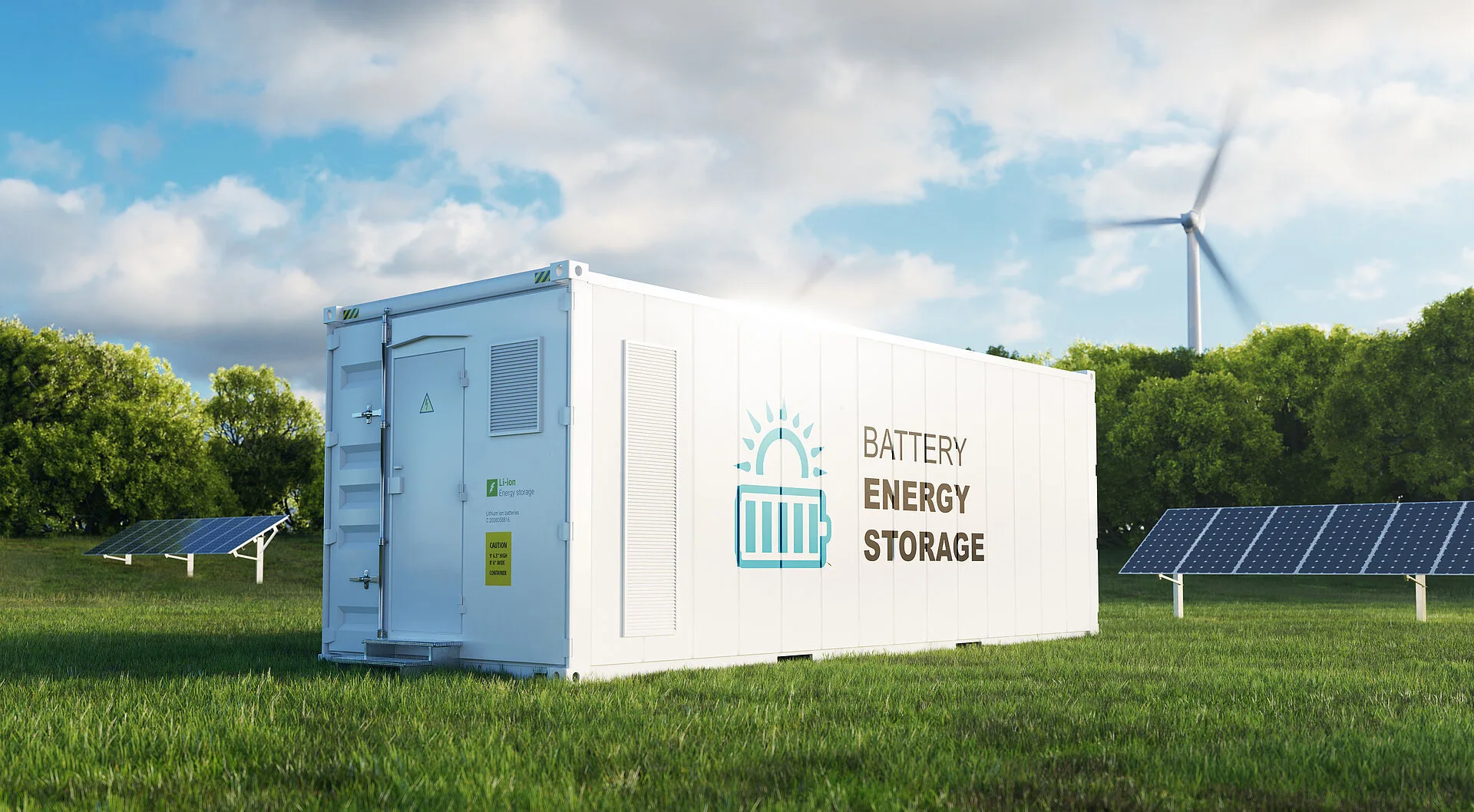
A commercial battery storage system is a behind-the-meter or site-level energy storage system designed for businesses, factories, logistics facilities, hospitals, hotels, farms, telecom sites, data centers and other commercial or industrial users.
Most professional commercial battery storage systems include:
- LFP battery cells, modules and racks;
- a battery management system;
- a power conversion system or bidirectional inverter;
- an energy management system;
- switchgear and electrical protection;
- thermal management;
- fire detection and suppression;
- metering and communications;
- optional grid-to-island switching equipment.
The battery stores energy, but the rest of the system determines whether that energy can be used safely and at the required time.
The PCS controls charging and discharging power. The BMS protects the cells. The EMS decides when the system should charge, discharge or retain energy for backup.
This is why comparing commercial energy storage batteries only by their listed kWh capacity can produce the wrong decision.

What Data Is Needed to Size Commercial Battery Storage?
1. Twelve Months of Interval Load Data
The commercial load profile is the most important sizing input.
A monthly electricity bill normally shows total consumption and the highest billed demand. It does not show:
- when the peak occurred;
- how long the peak lasted;
- whether it happened once or every working day;
- how much energy was consumed above the target demand;
- whether the peak coincided with solar production;
- how quickly the load changed.
NLR research on behind-the-meter energy storageused continuous 12-month commercial load datasets recorded in five-minute increments to evaluate demand charges calculated over a 15-minute period.
For an initial engineering assessment, collect:
- timestamp and interval duration;
- site load in kW;
- grid import and export;
- PV generation;
- generator output;
- power factor;
- outage records;
- missing-data indicators.
Fifteen-minute data is a suitable minimum for many commercial sites. Five-minute or one-minute data may be needed when compressors, pumps, lifts, welding equipment or other fast-changing loads determine the PCS rating.
2. Complete Electricity Tariff Information
The financial model must reproduce the customer’s actual bill rather than apply one average electricity price.
Collect:
- peak, shoulder and off-peak energy rates;
- monthly demand charges;
- seasonal demand charges;
- coincident peak charges;
- contracted-capacity charges;
- demand ratchets;
- export compensation;
- fixed service charges;
- taxes and levies;
- grid-service revenue, where applicable.
Two facilities can have the same commercial load profile but require different dispatch strategies because their tariffs are different.
One may benefit mainly from reducing the highest 15-minute grid demand. Another may create more value by charging during low-price hours and discharging during an evening peak.
3. Solar Production Data
Commercial solar battery storage must be sized from the relationship between PV generation and facility demand.
Useful information includes:
- hourly or 15-minute solar output;
- installed PV capacity;
- DC/AC ratio;
- inverter clipping;
- shading;
- export restrictions;
- curtailment;
- seasonal generation;
- planned PV expansion.
Where measured data is unavailable, use a recognized solar simulation rather than assuming that the panels produce at rated power for a fixed number of hours each day.
4. Critical-Load Information
Backup sizing requires a separate critical-load schedule.
Do not assume the entire site must remain energized unless continuous operation of every load is genuinely required.
Divide loads into groups such as:
- safety and emergency systems;
- communications and servers;
- refrigeration;
- pumps;
- production equipment;
- lighting;
- HVAC;
- office loads;
- deferrable loads.
Record the normal operating power, starting power, acceptable interruption time and required restart sequence.
A facility with a 180 kW average critical load may still require a PCS rated above 180 kW if several motors restart at the same time.
5. Site and Electrical Constraints
The study should also identify:
- transformer rating and current loading;
- service voltage;
- available fault current;
- grid import and export limits;
- generator rating;
- available installation space;
- ambient temperature;
- altitude;
- humidity;
- dust and sand exposure;
- salt mist;
- noise limits;
- fire-service access;
- expected future loads.
These conditions can change both the required size and the most suitable enclosure or cooling design.
kW vs kWh in Commercial Battery Storage
Understanding kW vs kWh is essential when learning how to size a battery energy storage system.
The terms are related, but they describe different parts of system performance.
kW Measures Power
The kW rating indicates how much power a BESS can charge or discharge at one moment.
For peak shaving:
Required BESS power = Maximum site demand − Target grid demand
Suppose a factory reaches 600 kW, but the owner wants grid import to remain below 480 kW.
The minimum battery output is:
600 kW − 480 kW = 120 kW
The final PCS rating may need additional capacity for:
- motor starting;
- reactive-power support;
- load fluctuations;
- overload requirements;
- grid-forming operation;
- future load growth.
Power determines whether the system can handle the load event.
kWh Measures Energy
The kWh rating indicates how much energy the battery stores.
A 100 kW/200 kWh system can theoretically discharge at 100 kW for two hours. A 500 kW/2 MWh system has four hours of nominal duration at its full rated power.
The basic relationship is:
Energy = Power × Time
For peak shaving, however, multiplying the single highest demand reading by an assumed duration may oversize the system.
A more accurate calculation measures the area of the load curve above the target:
Required AC energy = Σ max(Site load − Target demand, 0) × Interval duration
The maximum gap determines the required kW. The accumulated area above the target determines the required kWh.
What Is Usable Battery Capacity?
Nameplate capacity is not the same as usable battery capacity.
A battery may operate between 5% and 95% state of charge instead of using the full 0%–100% range. Energy is also consumed by the PCS, transformer, cooling system, pumps, fans, controls and communications.
At the beginning of life:
Usable DC energy = Nameplate energy × SOC operating window
Delivered AC energy = Nameplate energy × SOC window × discharge efficiency
For long-term sizing:
Required nameplate energy = Required AC energy ÷ (SOC window × discharge efficiency × end-of-life retention)
The U.S. Department of Energy’s BESS evaluation method distinguishes rated capacity from demonstrated capacity and adjusts its capacity ratio for the system’s minimum permitted state of charge.
Factors that reduce usable battery capacity include:
- minimum and maximum SOC limits;
- inverter and transformer losses;
- thermal-management consumption;
- high or low temperatures;
- altitude derating;
- calendar aging;
- cycle aging;
- backup reserve;
- manufacturer operating limits.
A project that must still deliver 300 kWh after ten years should not be commissioned with only 300 kWh of nameplate energy.
How to Size a Commercial Battery Energy Storage System
Step 1: Define the Primary Objective
Start with one measurable objective.
Examples include:
- keep grid demand below 500 kW;
- shift 400 kWh from midday to the evening;
- support critical loads for four hours;
- reduce generator runtime by 70%;
- maintain 100 kW of emergency reserve;
- avoid exceeding an agreed transformer limit.
“Reduce the electricity bill” is too broad for engineering design.
A battery can perform several functions, but the main objective should determine the preliminary size.
Step 2: Calculate the Required Power
For peak shaving, find the maximum difference between the facility load and the selected grid-demand target.
For backup power, calculate:
- the average critical load;
- the highest simultaneous load;
- the largest starting event;
- expected future growth.
For commercial battery storage for solar, check both the maximum charging power available from excess PV and the maximum discharge power required after solar production falls.
Step 3: Calculate the Required Energy
For backup:
Required AC energy = Average critical load × Backup duration
For solar shifting:
Useful shifted energy = The smaller of available solar surplus and later site demand
For peak shaving, integrate the load above the target across every relevant interval.
Do not size the battery from one exceptional day alone. The frequency of load events also affects cycle count, charging requirements and expected savings.
Step 4: Correct for Real Operating Conditions
Adjust the calculated AC requirement for:
- SOC operating window;
- discharge efficiency;
- end-of-life capacity retention;
- environmental derating;
- auxiliary consumption;
- a documented project allowance.
Avoid hiding several assumptions inside one arbitrary oversizing factor. SOC, efficiency, degradation and reserve should be shown separately.
Step 5: Confirm the Charging Window
A battery that discharges 500 kWh must have sufficient power and time to recharge.
Check:
- available off-peak hours;
- spare transformer capacity;
- maximum grid import;
- available solar surplus;
- generator loading;
- reserve required before the next outage.
A larger battery does not help if the site cannot recharge it before the next operating cycle.
Step 6: Run a Full-Year Simulation
A useful BESS sizing calculator should simulate every interval of the year rather than one “typical day.”
The model should report:
- monthly maximum demand before and after storage;
- annual energy charged and discharged;
- peak-demand savings;
- time-of-use savings;
- solar self-consumption;
- curtailment;
- equivalent full cycles;
- time spent at SOC limits;
- unmet backup demand;
- expected degradation.
TheNLR REopt techno-economic decision support platform can evaluate distributed energy technologies and identify suitable system sizes and dispatch strategies, although a bankable project still requires site-specific engineering review.
Step 7: Validate the Electrical and Safety Design
Before the preliminary result becomes a final specification, review:
- transformer loading;
- switchgear ratings;
- short-circuit levels;
- protection coordination;
- grounding;
- lightning protection;
- grid code;
- fire requirements;
- communications;
- cybersecurity;
- warranty operating conditions.
A BESS sizing calculator can identify a promising power and energy range. It cannot replace detailed electrical design.
Worked Example: Sizing a 125 kW/261 kWh BESS
Consider a manufacturing facility with the following measured profile:
| Input |
Value |
| Maximum site demand |
500 kW |
| Target grid-import limit |
400 kW |
| Required battery output |
100 kW |
| Time above the target |
1.5 hours |
| Required AC energy |
150 kWh |
| SOC operating window |
90% |
| Discharge efficiency |
94% |
| End-of-life retention |
80% |
The initial power requirement is:
500 kW − 400 kW = 100 kW
The required nameplate energy is:
150 ÷ (0.90 × 0.94 × 0.80) = 221.6 kWh
Adding a 10% project allowance:
221.6 × 1.10 = 243.8 kWh
A commercial battery storage system in the 125 kW/261 kWh class is therefore a reasonable preliminary candidate.
The HighJoule HJ-G0125-0261L liquid-cooled BESS cabinet has a published rated output of 125 kW and rated energy of 261.248 kWh.
Its published specifications include:
- LFP 314 Ah cells;
- a 672–864 V DC range;
- liquid cooling;
- IP55 protection;
- dimensions of 2385 × 990 × 1485 mm;
- approximate weight of 2.13 tonnes;
- operating temperature from −30°C to +55°C;
- derating above 45°C;
- optional grid/off-grid switching below 20 milliseconds.
These specifications are listed on the current HighJoule product page.
At the assumed operating conditions, estimated end-of-life AC energy would be:
261.248 × 0.90 × 0.94 × 0.80 = 176.8 kWh
That remains above the required 150 kWh.
This calculation is an initial screening result. The complete commercial load profile, tariff, charging window, transformer capacity, ambient conditions and warranty model still need to be reviewed.
How to Size Commercial Solar Battery Storage

Commercial solar battery storage should not be sized as a fixed percentage of the PV array.
A 500 kWp commercial solar power system may require very little storage if the facility consumes nearly all generation during the day. The same PV capacity may require a much larger battery where the site closes before the solar peak or grid export is restricted.
For each interval:
Solar surplus = max(PV generation − Site load − Permitted export, 0)
Available surplus energy is:
Surplus energy = Σ Solar surplus × Interval duration
The economically useful shifted energy is limited by the smaller of:
- available solar surplus; and
- facility demand after solar output falls.
Commercial solar battery storage systems should be modeled using:
- midday solar surplus;
- evening and nighttime demand;
- export restrictions;
- solar inverter clipping;
- weekends and holidays;
- seasonal production;
- charging power;
- backup reserve;
- AC- or DC-coupled architecture.
Do Not Size Commercial Solar Batteries from PV Capacity Alone
Suppose a site produces 300 kWh of surplus solar energy during the day.
That does not automatically justify a 300 kWh battery.
The designer must first check whether at least 300 kWh of suitable load occurs later. If the evening load is only 120 kWh, much of a 300 kWh battery may remain unused unless it serves another application.
The solar curve and commercial load profile must be analyzed together.
Why the Inverter Matters
The selection of the HighJoule photovoltaic storage inverter is part of the sizing process.
Inverter power, MPPT configuration, overload capability, on-grid/off-grid operation and system architecture can limit how much solar energy is captured and how much power reaches the load. The current HighJoule inverter category includes products for managing energy flow between PV, battery storage and site loads.
Commercial solar batteries should therefore be selected together with the PCS, inverter, EMS and site electrical system—not as isolated products.
How to Size Commercial Battery Storage for Backup Power
Backup sizing starts with critical loads, not total annual electricity consumption.
Assume a site has:
- 180 kW average critical load;
- a three-hour backup target;
- a 90% SOC operating window;
- 94% discharge efficiency;
- 80% end-of-life retention.
Required AC energy:
180 × 3 = 540 kWh
Required nameplate capacity:
540 ÷ (0.90 × 0.94 × 0.80) = 797.9 kWh
The preliminary requirement is approximately 0.8–1.0 MWh.
The PCS should provide at least 180 kW continuously, but a higher rating may be needed if pumps, compressors or HVAC equipment have large starting currents.
The design must also define:
- whether the whole site or only a critical-load bus is supported;
- acceptable transfer time;
- black-start requirements;
- grid-forming capability;
- generator synchronization;
- load-shedding sequence;
- minimum SOC reserved for unexpected outages.
When one battery is used for both daily energy management and backup, the EMS must protect the agreed reserve. Energy held for emergency operation cannot also be assumed to be fully available for daily arbitrage.

Commercial Battery Storage Sizing in the United States
U.S. projects are highly tariff-specific.
In May 2026, the average commercial electricity price was 13.54 cents/kWh. California averaged 24.10 cents/kWh, New York 22.40 cents/kWh and Texas 8.26 cents/kWh. These averages do not include every customer’s demand charge or time-of-use structure. Source: U.S. Energy Information Administration.
The same commercial battery storage system can therefore produce very different results in different states.
In California or New York, high energy prices, demand charges and resilience requirements may support solar-plus-storage. In Texas, the business case may depend more heavily on a specific demand tariff, grid-service opportunity, backup requirement or avoided transformer upgrade.
Qualified U.S. energy storage placed in service after December 31, 2024 may be eligible for the Section 48E Clean Electricity Investment Credit. The IRS lists a 6% base credit, with an increase to 30% when applicable prevailing-wage and apprenticeship requirements are met. Additional bonuses may apply to qualifying projects.
Eligibility and financial assumptions should be checked by qualified tax and legal advisers before being included in a project model.
U.S. projects may also need to address:
- UL 9540;
- UL 9540A;
- NFPA 855;
- the International Fire Code;
- the National Electrical Code;
- local utility interconnection requirements.
Commercial Battery Storage Sizing in Europe
Europe should not be modeled as one electricity market.
In the second half of 2025, the average non-household electricity price in the EU was €0.1837/kWh for customers using 500–2,000 MWh annually.
Germany averaged €0.2264/kWh, Ireland €0.2552/kWh and Finland €0.0748/kWh. Source: Eurostat.
These figures provide useful regional context, but final sizing must use the customer’s actual supply contract and network tariff.
A German factory, Romanian logistics facility and Danish grid-services site can have very different operating strategies even when their installed battery capacities are similar.
European commercial battery storage systems may need to consider:
- EN 50549;
- IEC 62619;
- IEC 63056;
- CE documentation;
- EU Battery Regulation requirements;
- national fire rules;
- distribution-network requirements;
- grid-service qualification.
A high annual electricity price does not automatically justify more storage. The time difference between low-price charging and high-price consumption is often more important.
Commercial Battery Storage Sizing in South Africa
South African projects should use the customer’s actual Eskom or municipal tariff.
For 2026/27, Eskom’s revised rates took effect on April 1, 2026 for direct customers and July 1, 2026 for municipal tariffs. Total standard tariffs increased by 8.76%, while local-authority tariffs increased by 9.01%.
Eskom also changed how part of its fixed cost is recovered through the Generation Capacity Charge. Source: Eskom 2026/2027 Tariff Increase.
This means reducing imported kWh may not reduce every part of the bill.
A South African commercial battery storage model should separately calculate:
- energy-charge savings;
- demand and capacity-charge savings;
- solar self-consumption;
- backup value;
- generator fuel reduction;
- avoided production losses.
High ambient temperature, dust, security, municipal interconnection requirements and transformer limitations should also influence system selection.
Commercial Energy Storage Solutions for Nigeria and Kenya
A single “African electricity price” should not be used when evaluating commercial battery storage solutions.
Nigeria’s service-based tariff system classifies customers according to expected daily supply. NERC lists minimum daily supply levels ranging from 20 hours for Band A to four hours for Band E.
For a Nigerian factory, telecom site or commercial building, the model should include:
- the customer’s tariff band;
- actual grid-availability hours;
- generator operating time;
- fuel consumption;
- fuel delivery;
- maintenance;
- production losses during outages.
At many weak-grid sites, diesel displacement and continuity of operation may be worth more than electricity-price arbitrage.
In Kenya, the Energy (Energy Management) Regulations, 2025 apply energy-management requirements to designated commercial, industrial and institutional facilities, including facilities consuming more than 180,000 kWh of electrical and thermal energy annually.
Large commercial energy storage solutions should therefore be considered as part of a wider energy-management program involving load efficiency, solar generation, power quality and operational controls.
Matching Commercial Battery Storage Solutions to the Application
HighJoule’s public project portfolio demonstrates why different sites require different configurations.
Examples include:
- two 125 kW/241 kWh air-cooled cabinets in South Africa, totaling 250 kW/482 kWh;
- 50 kWp of PV with a 125 kW/261 kWh BESS in Ghana;
- approximately 184 kWp of PV with 500 kW/1 MWh of storage in Romania;
- a 261 kWh system for a plastic-products factory in the Democratic Republic of the Congo;
- one 125 kW/261 kWh liquid-cooled cabinet in Denmark.
These configurations and additional projects are listed in the HighJoule global case library.
The examples show that capacity should follow the operating requirement:
| Application |
Possible Configuration Direction |
| Short peak shaving |
Power-focused C&I cabinet |
| Solar energy shifting |
One or more modular cabinets |
| Multi-hour critical backup |
Higher-energy cabinet bank |
| Weak-grid industrial site |
Solar + battery + generator hybrid |
| Large commercial microgrid |
Multiple cabinets or containerized BESS |
| Phased expansion |
Modular commercial battery storage systems |
HighJoule’s public case pages do not disclose every customer’s legal name. Where confidentiality applies, only the location, configuration and approved application details should be published.
Commercial Battery Storage vs Utility Scale Battery Storage
Commercial and utility scale battery storage may use similar LFP cells, but the systems are not sized in the same way.
| Factor |
Commercial Battery Storage |
Utility Scale Battery Storage |
| Connection point |
Behind the customer meter |
Transmission or distribution network |
| Primary input |
Site load and retail tariff |
Market dispatch and grid requirements |
| Main value |
Bill reduction, solar use, backup |
Capacity, balancing, energy shifting |
| Typical scale |
Tens of kWh to several MWh |
Several MWh to GWh |
| Space |
Often constrained |
Usually a dedicated site |
| Critical loads |
Frequently important |
Usually not a customer-load objective |
A standard two-hour assumption used in some utility projects should not automatically be applied to a factory, hospital, hotel or telecom facility.
Commercial duration must come from the load curve, outage target and charging opportunity.
How to Evaluate Commercial Battery Storage Economics
Demand-Charge Savings
Annual demand savings = Demand reduction × Demand rate × Chargeable months
The calculation should account for:
- demand ratchets;
- seasonal charges;
- measurement intervals;
- months with different load patterns;
- the probability of maintaining the target.
Time-of-Use Arbitrage
Arbitrage value = Discharged energy × Peak rate − Charging energy × Off-peak rate
Then subtract:
- conversion losses;
- degradation;
- auxiliary consumption;
- maintenance;
- EMS or aggregation fees.
Solar Self-Consumption
Solar-storage value = Stored solar used onsite × (Avoided import price − Export compensation)
Commercial solar battery storage tends to create more value where exported solar receives low compensation or where export is restricted.
Generator and Outage Savings
For African and other weak-grid markets, include:
- generator fuel;
- fuel transportation;
- fuel theft or delivery losses;
- generator maintenance;
- overhaul and replacement;
- low-load inefficiency;
- production downtime;
- spoiled materials;
- delayed orders;
- telecom-service losses.
Use LCOS, Not Only Purchase Price
The lowest equipment price per kWh is not always the lowest lifecycle cost.
Levelized cost of storage accounts for discharged energy over the system’s life and can include efficiency, cycle life, maintenance, augmentation and replacement. PNNL describes LCOS as a cost-per-unit-of-discharged-energy metric that supports more equal comparison between storage technologies.
Simple payback is:
Simple payback = Net installed cost ÷ Annual net benefit
A final investment decision should also consider discounted cash flow, degradation, financing, replacement assumptions and residual value.
Why One Global Battery Price Is Misleading
Statements such as “commercial storage costs $300/kWh” can be misleading because installed cost depends on more than battery capacity.
Project cost may include:
- battery modules;
- PCS and inverter equipment;
- BMS and EMS;
- cooling;
- fire suppression;
- transformer work;
- switchgear;
- civil foundations;
- shipping;
- local labor;
- import duties;
- interconnection studies;
- permitting;
- commissioning;
- warranty;
- future augmentation.
A 261 kWh outdoor cabinet installed beside a suitable existing transformer is not directly comparable with a multi-MWh project requiring medium-voltage equipment and a new substation.
Commercial battery storage solutions should therefore be compared using the same project scope and operating assumptions.
What Safety Standards Should Be Checked?
Requirements depend on the country, system and local authority.
| Region |
Common Areas to Review |
| United States |
UL 9540, UL 9540A, NFPA 855, IFC, NEC |
| Europe |
IEC 62619, IEC 63056, EN 50549, CE requirements |
| African markets |
Local grid code, fire approval, environmental adaptation |
UL Solutions states that the 2026 edition of NFPA 855 and the 2024 International Fire Code require fire or large-scale fire testing in certain circumstances. UL 9540A is the referenced thermal-runaway fire-propagation test method.
Certifications should be checked for the exact battery, PCS and system configuration being supplied. A certificate for one model does not automatically apply to another model or a modified cabinet arrangement.
What Are Good Battery Storage Options for Commercial Business Use?
The answer depends on the load, required duration and operating objective.
For many one- to four-hour applications, modular LFP cabinets provide a practical combination of cycling capability, installation flexibility and scalability.
| Business Requirement |
Suitable Option |
| 50–250 kW peak reduction |
Integrated outdoor LFP cabinet |
| 200 kWh–1 MWh solar shifting |
One or more modular C&I cabinets |
| Several hours of backup |
Higher-energy cabinet bank |
| Weak-grid operation |
Solar + battery + generator hybrid |
| Large industrial microgrid |
Containerized BESS |
| Very short interruption protection |
UPS or high-power battery system |
| More than six to eight hours daily |
Evaluate long-duration storage |
| Planned future expansion |
Modular cabinets with reserved capacity |
When comparing commercial energy storage batteries, buyers should review:
- usable capacity at the beginning and end of warranty;
- continuous and overload power;
- guaranteed throughput;
- round-trip efficiency;
- operating temperature;
- cooling method;
- fire-protection design;
- grid-forming capability;
- EMS functions;
- local service;
- spare-parts availability;
- augmentation strategy.
The best commercial energy storage solutions are not necessarily the systems with the largest nameplate capacity or lowest initial price.
They are the systems that match the site’s operating profile and continue meeting the required performance over time.
Common Commercial Battery Storage Sizing Mistakes
Using Monthly Bills Instead of Interval Data
A bill shows a monthly maximum but not the duration or shape of the demand event.
Focusing Only on kWh
The battery may contain enough energy but have insufficient PCS power to control the peak.
Assuming Every Project Needs Two Hours
Duration must come from the commercial load profile, backup requirement or solar-shifting window.
Ignoring the Charging Window
The site must have enough power and time to recharge before the next discharge cycle.
Treating Every Load as Critical
Separating essential and nonessential loads can significantly reduce backup-system cost.
Ignoring Future Expansion
New production lines, pumps, refrigeration or other equipment may make a newly installed battery undersized.
Using Beginning-of-Life Capacity Only
The system should still meet its performance requirement at the specified end-of-warranty capacity.
Adding Arbitrary Safety Margins
SOC, efficiency, degradation and environmental derating should be calculated separately.
Using a National Average Tariff
The customer’s real utility rate, demand period, export rule and supply reliability should be used.
Commercial Battery Storage Sizing Checklist
Before requesting a final quotation, prepare:
- Twelve months of 15-minute load data.
- Twelve months of electricity bills.
- Complete tariff documentation.
- PV production data or simulation.
- Critical-load list.
- Required backup duration.
- Transformer and switchgear information.
- Electrical single-line diagram.
- Generator specifications.
- Grid import and export limits.
- Site layout and photographs.
- Temperature and altitude information.
- Dust, humidity or salt-mist conditions.
- Planned future loads.
- Required certifications.
- Target commissioning date.
A supplier that recommends an exact battery size without these inputs is providing a product estimate, not a complete engineering result.
Frequently Asked Questions
How do you size a commercial battery storage system?
Calculate the required power from the maximum difference between the site load and target grid demand. Calculate energy by integrating that difference over time. Then adjust for SOC limits, efficiency, end-of-life retention, environmental derating and reserve capacity.
Can a system be sized from monthly electricity bills?
Monthly bills can support an initial screening study, but final sizing should use interval load data. Bills generally do not show how long demand peaks lasted.
What is the difference between kW and kWh?
kW measures instantaneous power and determines how much load the battery can support. kWh measures energy and determines how long it can support that load.
What is usable battery capacity?
Usable battery capacity is the energy available within the permitted SOC window. Delivered AC energy is lower after PCS losses, auxiliary consumption and environmental derating.
How much commercial solar battery storage is needed?
There is no universal battery-to-solar ratio. The system should be sized from solar surplus, later site demand, export restrictions, charging power and backup requirements.
Can commercial solar battery storage systems work with existing PV?
Yes. The existing solar inverter architecture, connection point, export controls and available surplus must first be reviewed to determine whether AC coupling, DC coupling or equipment replacement is appropriate.
What should a BESS sizing calculator include?
A credible BESS sizing calculator should include interval load data, tariffs, solar output, SOC limits, efficiency, degradation, charging constraints, backup reserve and full-year dispatch.
Is a two-hour battery suitable for every business?
No. A short demand peak may need less than two hours. Cold storage, data centers, water facilities and weak-grid factories may require four hours or more.
Should the battery be sized for beginning-of-life or end-of-life capacity?
Projects with firm performance requirements should verify that the system can still deliver the required energy at the agreed end-of-warranty capacity.
Can one battery provide both peak shaving and backup?
Yes, but the EMS must retain an agreed backup reserve. The same stored energy cannot be counted simultaneously for daily arbitrage and emergency operation.
What are good battery storage options for commercial business use?
Modular LFP cabinets are suitable for many peak-shaving, solar and backup applications. Larger industrial projects may require multiple cabinets or a containerized system. The final choice depends on kW, kWh, climate, grid conditions and operating strategy.
Conclusion
Accurate commercial battery storage sizing begins with data, not equipment selection.
A professional study should use at least 12 months of interval data, separate kW from kWh, calculate the actual energy above the demand target, adjust for usable battery capacity and aging, confirm the charging window and model the local tariff.
Commercial solar battery storage, backup power, peak shaving and weak-grid operation do not produce the same optimal configuration.
The economic drivers also vary by region.
In the United States, demand charges, state electricity prices and federal tax rules may shape the business case. In Europe, price spreads, grid constraints and national connection rules matter. In South Africa, tariff structure, solar self-consumption and backup requirements must be evaluated together. In Nigeria and Kenya, diesel displacement and operational continuity may be more valuable than electricity arbitrage.
The correct commercial battery storage solution is not the largest system available.
It is the system that delivers the required power and usable energy under real operating conditions, throughout its intended service life, with a technical and financial result that can be clearly explained.

 CablingFiber Distribution Box (Non-metal), Fiber Distribution Box (Metal), Fiber Cross-Connect Cabinet (SMC), ODF / Fiber Patch PanelData CenterNetwork Cabinet, Integrated Rack, Cable Tray (U-steel), Cable TrayPower DistributionRow PDU Cabinet (DC), Row PDU Cabinet (AC), Smart Busbar, Distribution Box / CabinetPower SupplyAC-DC Power Supply, Integrated Power Supply, Integrated Energy Cabinet, Base Station CompanionPassive Optical DevicesOptical Cable, Optical Splitter, Fiber Patch Cord / Pigtail, Fiber AttenuatorWirelessChameleon-Type Aesthetic Antenna RadomeOutdoor Cabinets & SheltersOutdoor Cabinet, Outdoor Shelter, Emergency Communications CabinetC&I Energy Storage SystemsEnergy Storage Cabinet, Microgrid System (Hybrid Energy), Energy Storage ContainerBase Station Energy StorageIndoor Photovoltaic Energy Cabinet, Outdoor Solar Energy Cabinet, Solar Micro Station Energy Cabinet, Base Station Battery CabinetMobile Solar ContainerFoldable Photovoltaic Power Generation Cabin, Foldable power generation and energy storage warehouse, Site Energy Photovoltaic ContainerMobile Energy StorageHJ-Mobile series mobile energy storage and charg…Customized ProductsHighjoule offers flexible, customized energy sol…Home Energy Storage SystemsAll-in-One Home Storage System, Portable Power Station, Complete Home ESS, Photovoltaic Storage InverterEnergy Storage AccessoriesCharging point, Photovoltaic module, Other complementary products


 Highjoule
 2026-07-30

